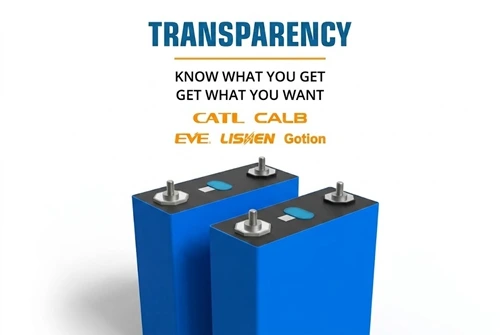
 Europe Warehouse Stock

Enclosure & structure
01- DIY enclosure 1× included
- Metal 1 set
- Adjustable cell compression plates & tie-rods 1 set
Premium server rack metal case kit tailored for EVE 314Ah, 356Ah and 628Ah cells. Includes heavy-duty busbars, wiring, and safety fuse.
High voltage stacked system case kit for 314Ah cells. Build custom high-voltage energy storage systems.
Plug-and-play home battery solution for solar self-consumption, backup power, and off-grid living. Seamlessly integrates with mainstream inverters.
High VoltageScalable high-voltage battery storage systems designed for commercial & industrial applications, peak-shaving, and microgrids.
Gobel VRM & Home Assistant & ioBrokerMonitor, manage, and optimize your solar storage systems in real-time. Seamless integration with VRM Portal and smart home automation platforms.

 China warehouse · 30–60 days
In stock · Ready to ship
DIY Battery Kits / Project Zeta
Case Kit · No Cells 51.2 V · DIY enclosure · Fits 356 Ah cells
Ask our engineering desk for the next intake date, or switch to an in-stock option above.
Ask about restock →Send your quantity, target inverter and delivery postcode and our engineering team will reply with a landed quote.
Request a quote →No laser welding. Pre-cut tinned copper busbars (16S layout) and metric fasteners bolt straight onto the cell studs.
Adjustable end-plates and tie-rods hold prismatic cells uniformly to limit swelling and protect cycle life.
CAN,RS485,RS232 ports are pre-wired for hybrid inverters that accept a BMS CAN or RS485 link.
Warranty terms are stated on this page and in the manual. Replacement BMS boards, screens and busbars ship separately by express air courier.
Bill of materials
Every hardware group below reflects the selections in the configurator above. Optional upgrades flip live between optional, selected and pre-order status.
Interactive engineering check
Check a real cell model (or enter custom dimensions) against this enclosure's clearance limits, pick your parallel bank size and inverter rating, and see the live pack estimate.
Checks run against the cell bay clearance, compatible capacity range, terminal style and the BMS parallel limit stored on this SKU.
Datasheet & dimensions
Every value on this page is read from the product's structured spec record — nothing here is a marketing estimate.
| Configuration | Case Kit · No Cells |
|---|---|
| Topology & nominal voltage | 16S1P · 51.2 V |
| Target pack energy | 18.23 kWh (@ 356 Ah) |
| Continuous charge / discharge | 170 A / 170 A (8.7 kW) |
| Main circuit breaker | 2P100A |
| BMS platform | PC200B (PC) |
| Active balancing current | 2 A active |
| Communication interfaces | CAN,RS485,RS232 |
| Enclosure form factor | Project Zeta |
| Case material | Metal · adjustable compression |
| Packed net weight | 45 kg |
| Compatible cell capacity | 356 Ah |
| Required cell terminal | Single Pole |
Fastener torque values are listed in the assembly manual for this enclosure.
Closed-loop interfaces carried by this BMS:
BMS & assembly reality
We state firmware ownership plainly before you buy, and publish the stepped voltage check that prevents a fried BMS board during commissioning.
| Decision factor | PCBMS · Selected |
|---|---|
| Firmware ownership | Maintained by Gobel Power (custom firmware support) |
| Bluetooth app | No — front LCD or WiFi module |
| Active balancing | 2 A active |
| Interfaces | CAN,RS485,RS232 |
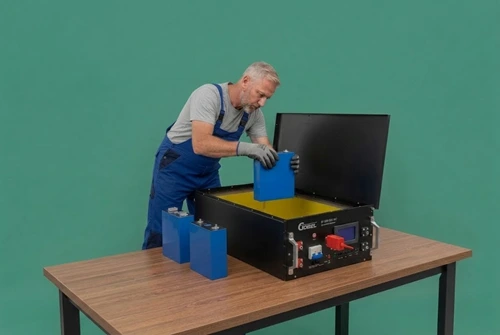
Mount casters or rack handles, the LCD display, the low-voltage switch and the insulated output terminals on a clean dry bench.
Line the outer walls with FR4 epoxy boards. Place cells with alternating polarity and insert an FR4 separator between every pair.
Tighten the steel compression end-plates and tie-rods evenly so the prismatic cells stay immobilised during cycling.
Fit the series copper busbars with spring and flat washers, then connect the power bars to the breaker and the BMS.
Mount the voltage sensing board and NTC probes. Measure every pin with a DC multimeter before you plug it into the BMS.
Plug in the BMS sense harness, switch on the low-voltage supply, verify the cell voltages on the LCD, connect the CAN or RS485 cable and close the DC breaker.
Black probe on B−, red probe stepping across B1 → B16. Every step must climb by one cell voltage before you connect the BMS.
• If any pin drops or jumps by more than 0.1 V, stop and re-check the busbar polarity before plugging into the BMS.
Complete your build
Pair this enclosure with batch-matched Grade A cells, add cloud telemetry, or switch to a factory-assembled battery if you would rather not pick up a wrench.
Matched cells
Grade A prismatic cells with factory capacity and IR matching, Single Pole terminals — the exact size that drops into this bay.
Cloud monitoring
Plug it into the BMS comm port for live state of charge, cell-level voltage alerts and remote diagnostics — available as an upgrade in the configurator above.
Prefer zero assembly?
Same cell architecture, assembled, tested and ready to connect straight out of the crate — no torque wrench required.
Global fulfilment
Steel enclosures travel in foam-lined export crates. Choose local regional stock for fast customs-cleared delivery, or Shenzhen factory direct for the lowest landed cost.
 EU warehouse
7–15 days
Already cleared locally for fast courier or pallet dispatch (0% EU import duty · Excl. VAT), with local support for verified quality issues.
China warehouse (Shenzhen)
This SKU · 30–60 days
Factory-direct DDP sea or rail freight worldwide. Replacement BMS boards, screens and busbars travel separately by express air courier in 5–7 days.
Frequently asked
Practical answers on cell fit, BMS setup, pre-order dispatch dates and warranty coverage.
No — the EVE 356Ah cells are NOT included and are sold separately. The kit brings everything else you need to build a 51.2V battery yourself:
The enclosure, busbars, and BMS parameters are sized specifically for EVE 356Ah prismatic LiFePO4 cells in a 16S1P configuration (51.2V nominal). Once cells are added you get 18.227 kWh of usable energy per module with 95% round-trip efficiency — at a lower cost than a factory-assembled module, since you keep the savings from building it yourself.
The PC200B is developed and maintained entirely by Gobel Power — unlike third-party BMS options such as the JK BMS, whose firmware and software are controlled by JK:
If you want a worry-free DIY build with full firmware support, the PC200B version is the recommended choice over the JK kits.
Yes. The PC200B talks over RS485 / RS232 / CAN / WiFi:
vrm.gobelpower.com — a demo account is on the product page)Bluetooth note: the PC200B itself has no Bluetooth — remote access is via the WiFi module, which is why the module is offered as an add-on alongside the optional heating pad and 250A bolt-fuse.
Yes — this kit is built to scale:
Parallel guidelines: only connect packs of the same capacity and same cell version (all EVE 356Ah, 16S1P); perform a full charge to 100% at least once a month so SOC readings stay synchronized across packs; and keep each pack's firmware version consistent.
Inverter compatibility: the PC200B BMS supports CAN / RS485 / RS232 communication, integrating with mainstream hybrid solar inverters in lithium battery mode (Deye, GoodWe, Growatt, Victron, Solis, Luxpower and more).
Inverter without a BMS communication input? Set it manually in lead-acid mode:
55.2V (3.45V per cell)150A200AWarranty:
Delivery:
A step-by-step GP-SR1-PC200 DIY kit manual is included in the related downloads.
Installers & bulk builds
Send your target kWh, inverter model and delivery postcode. Our engineering desk replies within one business day with pallet pricing and a complete wiring diagram.