

 Europe Warehouse Stock


LiFePO4 Battery DIY Kits

51.2 V · 1P16S · low voltage
Battery DIY Kits
A case, a 200 A BMS, busbars, a balance harness and a screen. You add sixteen LiFePO4 cells and torque them down — or buy the same kit with the cells already matched and in the same box.
16.1–32.2 kWh per pack JKBMS / HV BMU EU stock & China stock stock
Battery DIY kits in this collection
Platform 01 · 51.2 V
Project Zeta 314
51.2 V 16S LiFePO4 DIY case kit for solar and home energy storage — JKBMS or PCBMS, 2P100A breaker and compression hardware in one box. Takes 314 Ah prismatic cells for a 16.08 kWh home battery pack. Also sold as kit + cells with matched LiFePO4 cells.

 Single Pole Cells · 16S1P
Kit + Cells
314 Ah
16.08 kWh
7.68 kW
US$1,599.0020% off
EU stock · 7–15 days
 Single Pole Cells · 16S1P
Kit Only
314 Ah
16.08 kWh
7.68 kW
US$515.0023% off
EU stock · 7–15 days

 Single Pole Cells · 16S1P
Kit Only
314 Ah
16.08 kWh
7.68 kW
US$458.00
China stock · 30–60 days
 Single Pole Cells · 16S1P
Kit + Cells
314 Ah
16.08 kWh
7.68 kW
US$1,592.00
China stock · 30–60 days
Platform 02 · 51.2 V
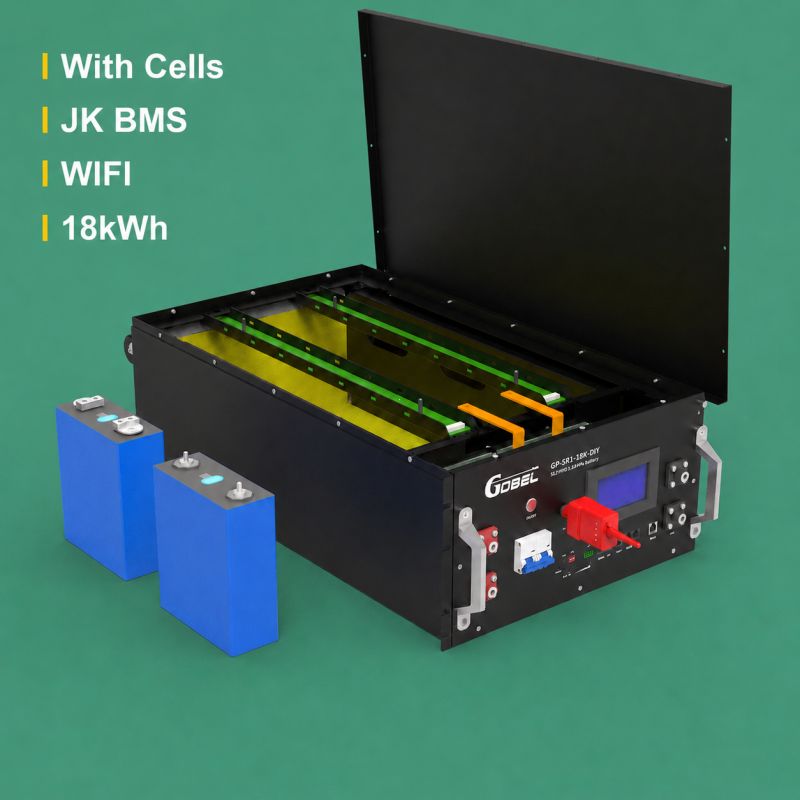
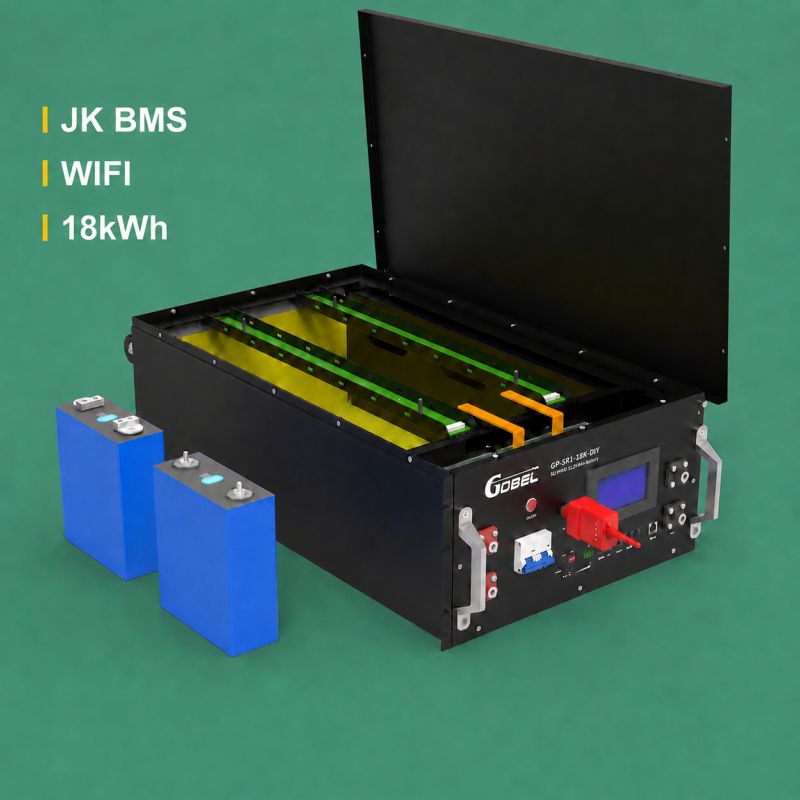
Project Zeta 356
Built around the JKBMS or PCBMS: a 51.2 V 16S DIY battery box for LiFePO4 solar storage. 356 Ah prismatic cells drop straight in for a 18.23 kWh battery pack. Single Pole terminals, Metal case and 2P100A breaker included. Also sold as kit + cells with matched LiFePO4 cells.
Platform 03 · 51.2 V
Project X 314
16.08 kWh home battery pack, shipped as a kit: 51.2 V 16S platform, JKBMS or PCBMS, Anti-Flame ABS case and 2P100A breaker. Add 314 Ah prismatic cells with Single Pole terminals to finish it.

Platform 04 · 51.2 V
Project X 628
51.2 V 16S LiFePO4 DIY case kit for solar and home energy storage — JKBMS or PCBMS, 3P100A breaker and compression hardware in one box. Takes 628 Ah prismatic cells for a 32.15 kWh home battery pack.

Platform 05 · 57.6 V
Project Sigma 314
Built around the HV BMU: a 57.6 V 18S DIY battery box for LiFePO4 solar storage. 314 Ah prismatic cells drop straight in for a 18.09 kWh battery pack. Single Pole terminals and Metal case included.

No kit matches that combination — ask us what is in stock
Add-ons · WiFi monitoring
Add the module that puts the pack on your phone
One plug-in module for the BMS comm port. Pick the one that matches the BMS platform of the kit or the cells you already run — PCBMS or JKBMS. Ships from the same warehouse as the rest of the order.

Bill of materials
What is in the box: complete hardware down to the last bolt
Every Gobel Power DIY kit provides the complete enclosure, smart BMS, high-current power path, and insulation system. You only supply the cells — every bracket, busbar, harness, and fastener is pre-matched and included.
01
Structure
Enclosure & Chassis
- Structural case (server rack or modular frame)Heavy-duty
- Integrated cell compression plates & tie rodsStandard
- Front & top service panels with coversIncluded
- Rack handles or floor castersPer model
- Industrial anti-corrosion powder finishAnti-rust
02
Control
BMS & Management
- 16S smart BMS (JKBMS or PCBMS platform)200A / 300A
- Active cell balancer with app control2A active
- Dual inverter communication portsCAN & RS485
- Digital LCD display or touch screenIncluded
- BMS mounting platePre-fitted
03
Power
Main Power Circuit
- Laser-cut cell series busbarsTinned copper
- DC circuit breaker / main disconnectHigh DC rated
- Heavy-duty insulated output terminals (+ / −)Solid copper
- Terminal & breaker link busbarsPre-cut
- Class-T safety fuse & mountOptional
04
Safety
Insulation & Protection
- Inter-cell epoxy separator boardsEpoxy FR4
- Cell-to-enclosure epoxy insulation boardsEpoxy FR4
- Insulating terminal caps & barrier shieldsFlame-retardant
- Insulator standoff supportsDielectric
- Case space-adjustment EVA cushioning padsHigh-density
05
Sensing
Sensing & Communication
- Voltage detection PCB boardsRigid PCB
- Inverter communication cableCAN / RS485
- PC diagnostic communication cable (USB–RS485 or RS232)Included
- Low-voltage push-button power switchLow voltage
- Internal main power rigid copper busbarsSolid copper
06
Hardware
Fasteners & Assembly Tools
- Cell terminal bolts with spring & flat washersGrade 8.8+
- Enclosure assembly screws & panel fixingsFull set
- Thread specification matched to cell studsM6 / M8 / M10
- T-handle hex wrench & specialized toolsIncluded
- Illustrated assembly guide & wiring diagramDownloadable
Not in the box — 16 LiFePO4 cells
Sixteen 3.2 V prismatic cells (280 Ah to 628 Ah). Kit-only SKUs let you source your own preferred cells; bundle SKUs include matched, batch-tested cells packed in the same crate.
Not in the box — standard workshop tools
A calibrated torque wrench, insulated screwdriver set, multimeter, safety glasses and gloves — standard workshop tools you likely already own. (Specialized tools like the T-handle wrench are included in the kit).
Assembly
No welding required: pure bolt-together assembly in six steps
Every connection uses pre-engineered rigid busbars, PCB sensing, and standard metric fasteners. If you can follow a torque specification and operate a multimeter, you can safely assemble a battery pack.
-
01
Pre-assemble the chassis
Fit the carrying handles or casters to the base frame. Mount the LCD display, low-voltage power switch, and insulated output terminals into the panels on a clean, insulated work bench.
-
02
Line insulation & position 16 cells
Place outer FR4 epoxy boards against the case walls. Stand all sixteen cells upright with alternating polarity (+ − + −), inserting FR4 separator boards between every cell pair and EVA foam pads for a snug enclosure fit.
-
03
Apply mechanical compression
Tighten the compression end-plates and tie-rods evenly. Standard mechanical compression (approx. 300 kgf across the stack) prevents prismatic cells from swelling during charge/discharge cycles, maximizing cell life.
-
04
Bolt busbars with a torque wrench
Install the series tinned copper busbars with spring and flat washers, then connect the internal rigid power busbars to the DC breaker and BMS. Always tighten to the exact torque spec — never torque by feel.
-
05
Install PCB sensing & verify voltages
Mount the PCB voltage detection boards and NTC temperature sensors. Before plugging into the BMS, verify every pin with a multimeter to confirm stepped voltages (3.2 V, 6.4 V... to 51.2 V). If any reading is off, halt and contact us.
-
06
Connect inverter comms & commission
Plug in the CAN or RS485 communication cable matched to your inverter brand (Victron, Deye, Sol-Ark, Growatt, etc.). Power on the BMS switch, verify the display, and close the DC breaker.
51.2 V nominal is safe against skin shock, but an accidental short circuit is not. A 16S battery pack can discharge thousands of amperes instantaneously into a dropped metal tool, causing severe arc flash, sparks, and molten metal. Never place tools or hardware on top of cells, remove all metal rings or watches, and always use insulated hand tools.
Which BMS
JKBMS or PCBMS — same 16S protection, different firmware control
Both are 16S, 200 A continuous, 2 A active balancing, CAN and RS485. The difference is how you watch the pack from a distance, and who can actually fix the firmware when something drifts.
| Spec | JKBMS (JK200) | PCBMS (PC200B) |
|---|---|---|
| Continuous current | 200 A, 10 kW at 51.2 V | 200 A, 10 kW at 51.2 V |
| Active balancing | 2 A | 2 A |
| Max parallel packs | 16 pcs | 63 pcs |
| Bluetooth | Yes — JK app, close range | No |
| Remote monitoring | Optional WiFi module → Gobel VRM | Optional WiFi module → Gobel VRM |
| Firmware | JK develops and maintains it. We report bugs and request updates, we cannot patch it. | Maintained by Gobel Power — firmware support comes with the kit. |
| Pick it when | Your system needs up to 16 packs in parallel — ideal for standard residential energy storage (up to ~256 kWh). | Your project requires large-scale expansion beyond 16 units — supports up to 63 packs in parallel (up to ~1 MWh) for commercial, farm, or microgrid storage. |
← Swipe horizontally to compare full specifications →
Project X2 ships with the 300 A JK BMS for 628 Ah cells (paired with a 2P200A breaker or optional Class-T 500 A fuse), supporting up to 16 packs in parallel for a total bank capacity of up to 514 kWh.
LiFePO4 cells bought with a kit. The BMS is 1 year, hardware only — the electronics age faster than the chemistry.
Ships from the German warehouse, VAT prepaid, no duty invoice at the door. 30 days free return to the local warehouse.
Sea freight, tax already paid. Spare parts and a replacement BMS go by UPS or DHL instead.
The full assembly manual and the inverter wiring diagram are public. Read the torque table before you decide.
Before you buy
DIY battery kits: questions that come up on every build
Anything not covered, [email protected] answers within one business day.
Ask an engineerDo I have to buy the cells from you?
No. Kit-only SKUs are completely turnkey except for the cells. Any standard prismatic LiFePO4 cells matching the enclosure dimensions and terminal specifications (e.g. 280–314 Ah, 356 Ah, or 628 Ah) will fit the respective case. Buying cells bundled with the kit ensures matched batches and single-shipment logistics, but it is not a condition of hardware warranty.
Which cells fit which kit enclosure?
Each kit is engineered around standard prismatic LiFePO4 cell form factors and terminal types: 280–314 Ah cases fit standard single-stud cells (e.g. 280K, 304 Ah, MB31 314 Ah) for a 14.3–16.1 kWh pack. 356 Ah cases are tailored for 356 Ah cells (e.g. LF356) for an 18.2 kWh pack. 628 Ah cases are built specifically for extra-large 628 Ah cells (e.g. MB56) for a 32.15 kWh pack. Always verify cell dimensions and terminal style before ordering.
My inverter has no lithium port. Does the kit still work?
Yes, in lead-acid or voltage-based mode: set maximum charge voltage to 55.2 V (3.45 V per cell), 150 A charge current, 150 A discharge. The smart BMS provides full autonomous protection against over-charge, over-discharge, over-current, and abnormal temperature regardless of whether the inverter communicates with it. The battery screen and app continue to display real-time cell voltages and live SOC.
Do prismatic cells really need mechanical compression?
Yes. Prismatic LiFePO4 cells naturally expand and contract as lithium ions move during charge and discharge cycles. Proper mechanical compression (approx. 300 kgf across the cell stack) prevents internal electrode delamination, reduces capacity degradation, and ensures cells achieve their rated 6,000+ cycle life. Every Gobel Power kit includes integrated compression plates, heavy-duty tie rods, and FR4 insulation to maintain uniform, calibrated pressure.
Can I put multiple battery packs in parallel?
Yes, provided all parallel packs share the same nominal voltage, capacity, and cell chemistry (never mix different capacities like 314 Ah with 356 Ah). Maximum parallel scaling depends on the BMS platform: JKBMS supports up to 16 packs in parallel (up to ~256 kWh on 314 Ah, or 514 kWh on 628 Ah); PCBMS supports up to 63 packs in parallel (up to ~1 MWh+) for commercial or microgrid storage. Fully charge all packs before connecting in parallel.
How is BMS warranty and firmware support handled?
All BMS units include a 1-year hardware warranty and direct Gobel Power technical support for setup and inverter protocol matching. For firmware: JKBMS firmware is developed and maintained by JK; PCBMS firmware is maintained directly by Gobel Power engineering, allowing rapid protocol updates and dedicated long-term firmware support.
Is a DIY kit actually cheaper than a finished battery?
Yes. The enclosure and BMS represent roughly one-third of total build cost, while the 16 cells account for the rest. Building with a DIY kit provides three major benefits: Cost savings: avoids factory assembly labor and high shipping surcharges for heavy pre-built batteries; Transparency: you choose and verify your own cell grade and batch; 100% Repairability: every component can be individually inspected, serviced, or upgraded over time.
Keep looking
Related LiFePO4 cells and battery collections
Send your inverter label. We’ll match the exact kit.
Inverter model, and the cell you plan to use if you already have one. You get back the right case, the BMS protocol file it needs, and whether 356 Ah is worth the extra $2 a cell over 314 Ah.
Mon–Fri · [email protected] · +86 134 8066 9029





